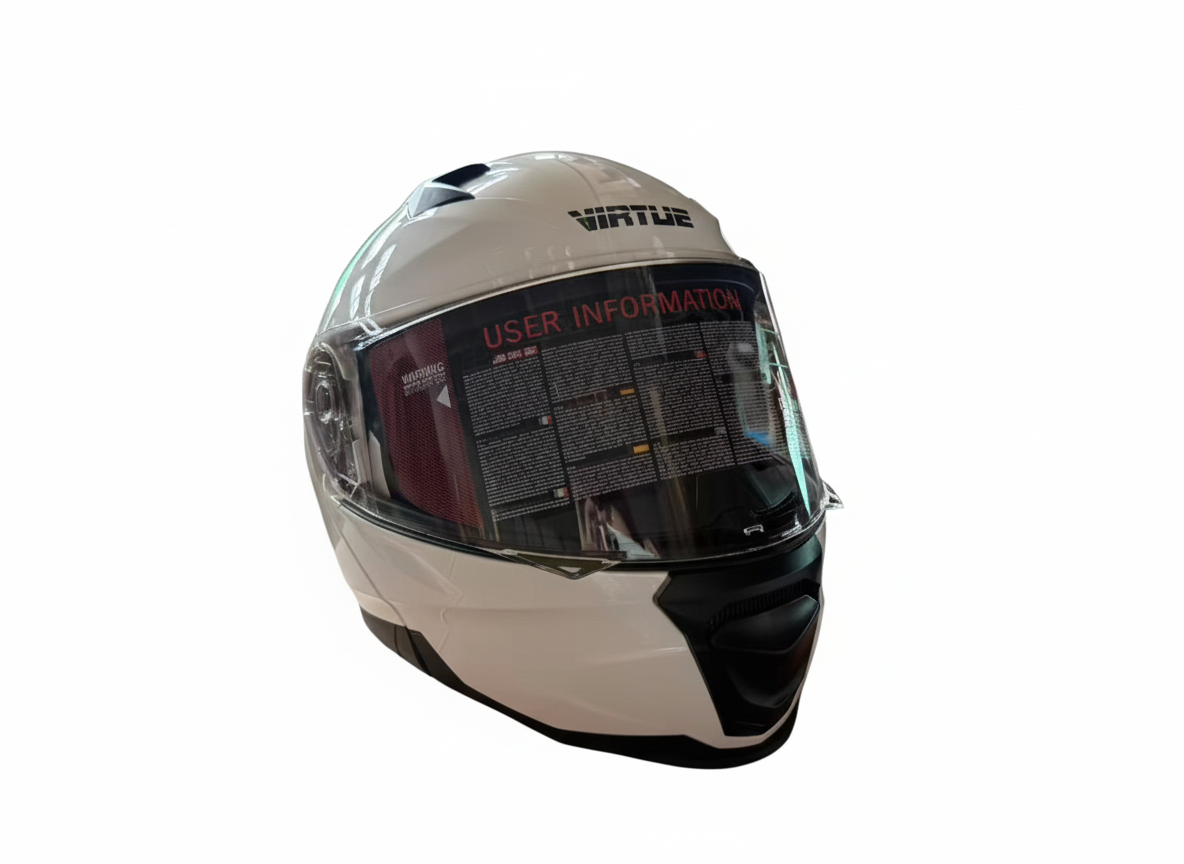
Virtue Helmet designed for Motorcyles and Mopeds with top safety features including ECEE522R06-Colour White
Virtue Helmet designed for Motorcyles and Mopeds with top safety features including ECEE522R06-Colour White
Safety Certificate Link
General Helmet Description
The V80 is a protective helmet designed for motorcycle and moped riders3. It is produced in sizes ranging from XS (53/54) to XL (61)4444. The helmet is marketed under several trade names, including VIRTUE.
Key Safety Features
-
Impact Absorption and Shell Construction:
-
Outer Shell: Constructed from high-strength ABS (Acrylonitrile Butadiene Styrene) plastic manufactured by injection
-
Protective Padding: Uses EPS (Expanded Polystyrene) of varying densities depending on the helmet size to maximize energy absorption777777. For example, the XL size uses a combination of densities (55+30+65+75 $Kg/m^3$) across the main, top, ear, and mouth areas
-
Modular Design (P/J Homologation):
-
The helmet features a movable protective lower face cover9. The "P/J" classification indicates it is certified for safety both as a full-face helmet (protective bar closed) and a jet helmet (protective bar open)
-
Vision and Shielding:
-
Primary Visor: A transparent Optical Polycarbonate visor (2.0 mm thick) that is scratch-resistant on the outer surface. It provides over 80% luminous transmittance.
-
Sun Shield: An integrated tinted shield made of optical polycarbonate (1.8 mm thick) with over 35% transmittance for daytime use.
-
Retention System:
-
The helmet utilizes a 21 mm wide nylon chin strap equipped with a quick-release mechanism for secure fastening and ease of use.
-
Ventilation:
-
The design includes a comprehensive ventilation system with top, rear, and mouth vents made of ABS to manage temperature and airflow.
-
Comfort and Hygiene:
-
Interior padding consists of compound sponge and cloth. Materials in contact with the skin are declared non-allergenic, transpiring, and resistant to sweat and hygiene products.
Test Performance Summary
The helmet successfully passed all rigorous ECE 22.06 testing requirements conducted by CETOC Technical Service in Italy:
-
Impact Tests: Passed standard linear, extra point, and hi/low energy impact tests across all sizes.
-
Rotational Acceleration: Passed oblique impact tests measuring Peak Resultant Acceleration (PRA) and Brain Injury Criterion (BrIC), which are critical for reducing brain injury risk during crashes.
-
Retention Reliability: Passed dynamic displacement, residual displacement, and micro-slip tests to ensure the helmet remains securely on the head during an impact.
The provided documentation confirms that the V80 helmet, manufactured by Wenzhou Virtue Motorcycle Fittings Co., LTD., has received ECE type-approval (E522R06/020012*00) pursuant to UN Regulation No. 22.06. This helmet is classified as a modular helmet with a movable protective lower face cover (P/J)
The V80 helmet successfully passed all ECE 22.06 impact tests across its full size range (XS to XL). These tests measure how effectively the helmet absorbs crash energy to prevent severe head and brain injuries.
Below are the detailed performance results for the XL (61 cm) size, representing the worst-case scenario due to its shell-to-padding ratio.
1. Standard Linear Impact Tests
Helmets were dropped at 7.5 m/s onto flat and kerbstone anvils. The results must remain below a maximum deceleration of 275 g and a Head Injury Criterion (HIC) of 2,400.
|
Impact Point |
Anvil Type |
Condition |
Speed (m/s) |
HIC (Limit: 2,400) |
Deceleration (Limit: 275 g) |
|
Front (B) |
Kerbstone |
Ambient |
7.53 |
1042 |
138 g |
|
Side (X) |
Flat |
Ambient |
7.58 |
2036 |
224 g |
|
Rear (R) |
Flat |
Ambient |
7.55 |
1465 |
172 g |
|
Crown (P) |
Flat |
Cold ($-10^{\circ}C$) |
7.51 |
1831 |
210 g |
2. Linear High/Low Energy Impacts
These tests evaluate performance at varying speeds to ensure protection in both minor and severe crashes.
-
Low Energy (6.0 m/s): The XL-8 sample recorded a peak deceleration of 171 g and HIC of 1103, well within the limits of 180 g and 1,300 HIC.
-
High Energy (8.2 m/s): The XL-9 sample recorded a peak deceleration of 260 g and HIC of 2413, passing the limits of 275 g and 2,880 HIC.
3. Rotational Acceleration (Oblique Impact)
A critical new feature of ECE 22.06, this test simulates glancing blows that cause the head to twist during a crash.
-
Peak Resultant Acceleration (PRA): Recorded at 3439 $rad/s^2$ (Limit: 10,400 $rad/s^2$).
-
Brain Injury Criterion (BrIC): Recorded at 0.35 (Limit: 0.78).
Note: Lower scores in rotational testing indicate a significantly reduced risk of traumatic brain injuries such as concussions.
4. Structural Integrity & Rigidity
The helmet was subjected to a crushing load of 630 N to measure deformation.
-
Longitudinal Deformation: 19.7 mm (Limit: 40 mm).
-
Transversal Deformation: 11.9 mm (Limit: 40 mm).
-
Final Residual Deformation: 2.8 mm (Limit: 15 mm), indicating the shell effectively maintained its shape after the load was removed.
Couldn't load pickup availability
Low stock: 2 left
View full details